

I found some plastic syringes but there is way too much friction on the plunger for the gas bottle to move it.
What are you guys using to measure and inject very small volumes of gas?
thx
where do I get a gas syringe?
-
Gun Freak

- Lieutenant 5

- Posts: 4971
- Joined: Mon Jan 25, 2010 4:38 pm
- Location: Florida
- Been thanked: 8 times
dude just pull the plunger back yourself to the right volume then inject the gas... :tongue3:
OG Anti-Hybrid
One man's trash is a true Spudder's treasure!
Golf Ball Cannon "Superna" ■ M16 BBMG ■ Pengun ■ Hammer Valve Airsoft Sniper ■ High Pressure .22 Coax
Holy Shat!
One man's trash is a true Spudder's treasure!
Golf Ball Cannon "Superna" ■ M16 BBMG ■ Pengun ■ Hammer Valve Airsoft Sniper ■ High Pressure .22 Coax
Holy Shat!
-
clemsonguy1125

- Sergeant 5

- Posts: 1485
- Joined: Tue Jul 21, 2009 4:00 pm
- Location: East Coast
Gun Freak, wouldnt there be oxygen in the mix which would mess up the fuel mixture. when the pressure pushes it back there mostly gas
Last edited by clemsonguy1125 on Fri Jul 23, 2010 1:57 pm, edited 1 time in total.
That is all.


An insulin syringe should do the trick, or if not you could cast an epoxy piston inside of a pen tube or something and make one yourself.
mobile chernobyl wrote:I can shoot a Canuter Valve off my '82 Chevy Ram F150 AT LEAST 3/4 Mile with 'ma cannon made of soup cans duct taped together, then I just squirt some bacardi 151 in the chamber and hold up my cigarrete lighta and WHOOSH! That thing flies at least 3/4 mile
-
jimmy101

- Sergeant Major 2


- Posts: 3210
- Joined: Wed Mar 28, 2007 9:48 am
- Location: Greenwood, Indiana
- Has thanked: 7 times
- Been thanked: 18 times
- Contact:
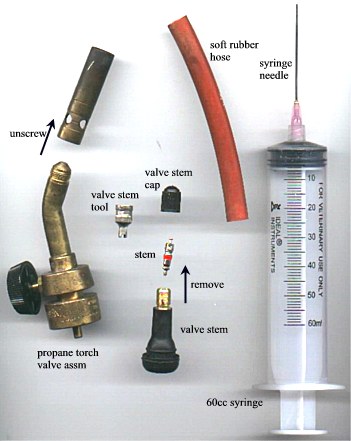
A generic plastic big-ass "veterinarian" syringe usually works just fine. If the inlet to the syringe is sealed into the outlet of the gas source then there is more than enough pressure in the gas tank to push the syringe back. (Heck, there is enough pressure to explode the plastic syringe body  )
)
I just rumage up a hunk of rubber hose (preferably not pressure rated to any great extent) that matches both the tip of the syringe and the pipe on my Bernzomatic torch (with the air mixer removed). Slide the hose on the pipe, slide the end of the 60cc syringe into the other end and crack open the valve on the tank. If you over pressurize the system you'll just pop the hose off at one end, no biggy.
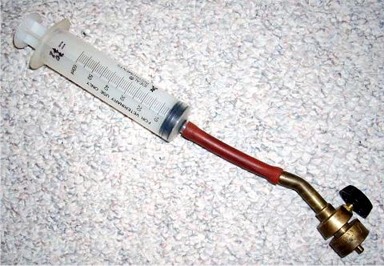
Or, you can use a disposable butane lighter and the piece of insulation from a piece of wire as the hose. Probably need a needle on the syringe to mate the syringe to the small ID "hose".
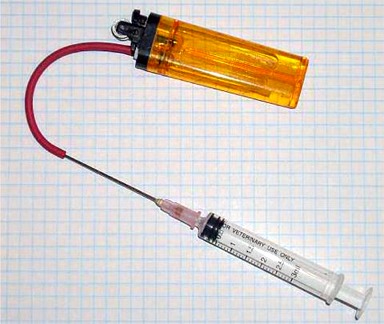
)I just rumage up a hunk of rubber hose (preferably not pressure rated to any great extent) that matches both the tip of the syringe and the pipe on my Bernzomatic torch (with the air mixer removed). Slide the hose on the pipe, slide the end of the 60cc syringe into the other end and crack open the valve on the tank. If you over pressurize the system you'll just pop the hose off at one end, no biggy.
Or, you can use a disposable butane lighter and the piece of insulation from a piece of wire as the hose. Probably need a needle on the syringe to mate the syringe to the small ID "hose".

-
jackssmirkingrevenge

- Five Star General

- Posts: 26219
- Joined: Thu Mar 15, 2007 11:28 pm
- Has thanked: 582 times
- Been thanked: 348 times
I suspect he's using one of these, as opposed to the rubber types:jimmy101 wrote:A generic plastic big-ass "veterinarian" syringe usually works just fine. If the inlet to the syringe is sealed into the outlet of the gas source then there is more than enough pressure in the gas tank to push the syringe back. (Heck, there is enough pressure to explode the plastic syringe body

hectmarr wrote:You have to make many weapons, because this field is long and short life


For my meter I used that torch head but instead of hose I used a 7.62x54R casing that I slide over the tip as a reducer with a .22 inside of it to fit the syringe. It's nice because it is compact and still lets me use the torch for it's intended propose.


Propane does not provide the kind of pressure needed to blow apart a syringe. For the benefit of those who aren't aware, Propane's pressure is usually between 70-150 psi, depending on temperature.jimmy101 wrote:Heck, there is enough pressure to explode the plastic syringe body
Although I don't recommend it - plastic soda bottles can hold that pressure. And they have a much larger diameter, but much thinner walls - i.e. they're considerably weaker.
Despite their lesser structural strength, I've had over 200 psi (which I really don't recommend) in some such bottles.
By my reckoning, most syringes probably have a burst pressure which is probably into the thousands of psi, or at least approaching it.
Further more, the fact that the syringe body would start to stretch outwards before rupture means that the pressure would vent past the syringe plunger - making rupture near impossible.
Sorry jimmy, while you often have some good, well-informed and important things to say, that particular example is at completely the other end of the spectrum.
Does that thing kinda look like a big cat to you?
-
jackssmirkingrevenge
- Five Star General
- Posts: 26219
- Joined: Thu Mar 15, 2007 11:28 pm
- Has thanked: 582 times
- Been thanked: 348 times
I would agree that the plunger would blow out of the end before burst pressure is reached, but I severely doubt most disposable syringes would take more than a couple of hundred psi before bursting, especially as you go up in capacity.Ragnarok wrote:By my reckoning, most syringes probably have a burst pressure which is probably into the thousands of psi, or at least approaching it.
hectmarr wrote:You have to make many weapons, because this field is long and short life
-
jimmy101
- Sergeant Major 2
- Posts: 3210
- Joined: Wed Mar 28, 2007 9:48 am
- Location: Greenwood, Indiana
- Has thanked: 7 times
- Been thanked: 18 times
- Contact:
Seeing as how the syringes are not pressure rated and are typically used in low pressure application, there pressure failure characteristics are completely unknown. They may well take 1,000 PSI, or they might not. In the absence of a defined spec then it must be assumed they may fail at relatively modest pressures. That is the only reasonable statement that can be made. Therefore, my statements are technically, logically and safety correct.Ragnarok wrote: Sorry jimmy, while you often have some good, well-informed and important things to say, that particular example is at completely the other end of the spectrum.
A plastic soda bottle is spec'd, designed and tested to withstand a couple hundred PSI. Just because a syringe is also made of plastic it is really silly to assume that it's failure characteristics are in anyway similar to a plastic soda bottle.
-
jackssmirkingrevenge
- Five Star General
- Posts: 26219
- Joined: Thu Mar 15, 2007 11:28 pm
- Has thanked: 582 times
- Been thanked: 348 times
The plastic syringes are usually made of tends to shatter quite readily, in start contrast to the properties displayed by soda bottles, so failure at a few hundred psi is more than likely.jimmy101 wrote:A plastic soda bottle is spec'd, designed and tested to withstand a couple hundred PSI. Just because a syringe is also made of plastic it is really silly to assume that it's failure characteristics are in anyway similar to a plastic soda bottle.
If I wasn't constrained by my urban surroundings I would happily put this to the test...
hectmarr wrote:You have to make many weapons, because this field is long and short life
No. The fact that something is typically used under low pressure and is not pressure rated does not mean that its failure characteristics are unknown.jimmy101 wrote:Seeing as how the syringes are not pressure rated and are typically used in low pressure application, their pressure failure characteristics are completely unknown.
I've personally had syringes under pressures in excess of those normally exhibited by propane without any signs of failure.
While I was doing serious testing of them as "poor man's" gas cylinders (back at a time when I was looking at the world's most ghetto semi-auto), I imagine there are enough other people here who have done impromptu "pressure tests" themselves.
That is to say, there are probably more than enough people who have tried to see how much they could squash down a syringe plunger while they held their thumb over the end. Anyone with reasonably strong hands could achieve pressures of 100, 150, 200 psi that way. I doubt many of them have "exploded".
While I admit that "thousands of psi" was more hyperbole than fact (mostly because what comes to mind when I think of a syringe is the smaller sizes, which will have relatively thicker walls for their diameter), I still maintain that almost any syringe - excluding those obviously unsuitable - will take whatever pressure propane is likely to be under.
While I would agree that is the correct assumption to make, my emphasis would be on the world may.In the absence of a defined spec then it must be assumed they may fail at relatively modest pressures.
There is a world of difference between telling someone that it may fail - which, as I said, would probably be rather less violent than you implied - and your definite statement that "there is enough pressure to explode the plastic syringe body".
One statement is good practice. The other is a very unlikely situation that could happen under the unfortunate coincidence of multiple pieces of improbable bad luck.
Just because I use something as an analogy does not mean it was part of my reasoning process.A plastic soda bottle is spec'd, designed and tested to withstand a couple hundred PSI.
And besides, I have to object against the suggestion that something is automatically less good at something because it wasn't designed for the purpose.
Attempts to make a refrigerant resulted in one of the lowest friction materials known to man - Teflon. (Ironically, one of the few materials with lower friction than Teflon was also a failed attempt to create something entirely different. It's also one of the hardest materials known to man, also by accident.)
Attempts to make a clear plastic for gun sights produced a very versatile adhesive - Superglue.
None of those were designed for what they now do every day, but they still do it better than many things that were designed for the purpose. Sometimes things are just better by accident.
Does that thing kinda look like a big cat to you?
-
jimmy101
- Sergeant Major 2
- Posts: 3210
- Joined: Wed Mar 28, 2007 9:48 am
- Location: Greenwood, Indiana
- Has thanked: 7 times
- Been thanked: 18 times
- Contact:
Object if you like but i'll bet that the folks that invented Teflon treated it with kids gloves until they new what they were doing. Even then it took something like 40 years to discover the risks associated with overheating a Teflon coated pot. Even when the hazards are "known" that doesn't mean there are not still unknown hazards. Plus, wanna guess what the education level and background of the discover of Teflon was? Do you think it was a couple teenagers working out in the garage? Figure they were PhDs in chemistry working in one of the best equipped chemical research facilities in the word (Dupont). google google Yep Plunkett, the discoverer had a PhD in chemistry. google google yep the precursor is toxic and has a nasty habit of exploding when not handle properly.
Yes, often things work very well for tasks other than what they were designed. But to suggest to someone that there is no risk in using a $2 plastic syringe on a propane tank that may well be sitting at 200 PSIG (easily on a hot day of the tank is in the sun) is irresponsible. Especially when it is likely they will be holding the syringe in their hand.
Edit:
Did more reading on the discovery of Teflon. I think it fits my paranoia better then I thought. Plunkett was a PhD chemist working on Freons (there are many thousands of Freons). He wasn't a polymer chemist. The precursor to Teflon if tetraflouroethylene (PFE). A polymer chemist would have recognized that PFE is a polymer precursor. Very little was known about PFE but Plunkett wanted to make enough in a single batch to keep from having to remake it, so he made up 100 pounds (!!!) of the gas. On storage overnight the pressurized PFE gas polymerized into Teflon in the storage vessel. A great example of serendipity. Also a great example of nearly killing himself. When the PFE polymerized it would have released heat. In the pressure vessel the pressure would have spiked with the rising temperature as heat was released by the reaction. He could have easily exceeded the pressure rating of the vessel. Indeed auto polymerization of PFE has been known to cause explosions.
A polymer chemist would never had made up 100 pounds (!!!) of precursor without first investigating the potential for auto polymerization, or if polymerization might be catalyzed by the material the container is made out of, or by storage at high pressure.
So, Plunkett discovered a very useful material completely unrelated to what he was looking for. He also came this close to killing himself or a lab mate. 100 lbs of compressed gas that suddenly, and spontaneously, exotherms is damn scary. It makes a hand grenade look like a firecracker. Imagine what just 1 pound of acetylene (a polymer precursor) would do if it was improperly stored in a pressure vessel.
When I was in school another chem grad student had a large scale Grignard reaction exotherm on him. He probably had tens of grams (not 100 pounds!) of material in a liter or two of diethyl ether (figure that's another couple of pounds). It ruptured the vented and temperature and pressure rated lab glassware. He was caught in the throat by a shard of glass. The last I heard was a couple years later, he was still in a comma.
Yes, often things work very well for tasks other than what they were designed. But to suggest to someone that there is no risk in using a $2 plastic syringe on a propane tank that may well be sitting at 200 PSIG (easily on a hot day of the tank is in the sun) is irresponsible. Especially when it is likely they will be holding the syringe in their hand.
Edit:
Did more reading on the discovery of Teflon. I think it fits my paranoia better then I thought. Plunkett was a PhD chemist working on Freons (there are many thousands of Freons). He wasn't a polymer chemist. The precursor to Teflon if tetraflouroethylene (PFE). A polymer chemist would have recognized that PFE is a polymer precursor. Very little was known about PFE but Plunkett wanted to make enough in a single batch to keep from having to remake it, so he made up 100 pounds (!!!) of the gas. On storage overnight the pressurized PFE gas polymerized into Teflon in the storage vessel. A great example of serendipity. Also a great example of nearly killing himself. When the PFE polymerized it would have released heat. In the pressure vessel the pressure would have spiked with the rising temperature as heat was released by the reaction. He could have easily exceeded the pressure rating of the vessel. Indeed auto polymerization of PFE has been known to cause explosions.
A polymer chemist would never had made up 100 pounds (!!!) of precursor without first investigating the potential for auto polymerization, or if polymerization might be catalyzed by the material the container is made out of, or by storage at high pressure.
So, Plunkett discovered a very useful material completely unrelated to what he was looking for. He also came this close to killing himself or a lab mate. 100 lbs of compressed gas that suddenly, and spontaneously, exotherms is damn scary. It makes a hand grenade look like a firecracker. Imagine what just 1 pound of acetylene (a polymer precursor) would do if it was improperly stored in a pressure vessel.
When I was in school another chem grad student had a large scale Grignard reaction exotherm on him. He probably had tens of grams (not 100 pounds!) of material in a liter or two of diethyl ether (figure that's another couple of pounds). It ruptured the vented and temperature and pressure rated lab glassware. He was caught in the throat by a shard of glass. The last I heard was a couple years later, he was still in a comma.
Create an account or sign in to join the discussion
You need to be a member in order to post a reply
Create an account
Not a member? register to join our community
Members can start their own topics & subscribe to topics
It’s free and only takes a minute
Sign in
-
- Similar Topics
- Replies
- Views
- Last post
-
- 2 Replies
- 4156 Views
-
Last post by jimmy101
-
- 8 Replies
- 4647 Views
-
Last post by jackssmirkingrevenge
-
- 8 Replies
- 3068 Views
-
Last post by SPG
-
- 3 Replies
- 3913 Views
-
Last post by Spitfire
-
- 2 Replies
- 2813 Views
-
Last post by MrCrowley


