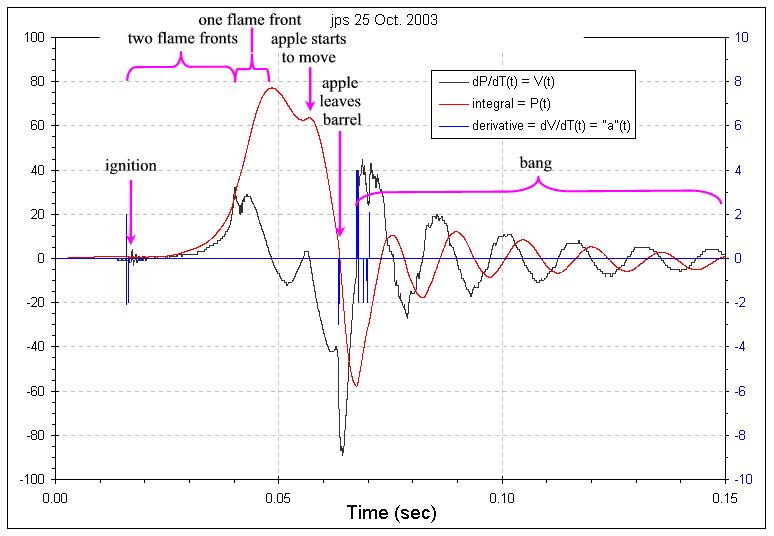
Technician1002 wrote:Wow, looking at the raw signal shows severe loading on the piezo. The huge negative spike as the pressure peak passed is a good indication.
Or, it's the high-pass filter on the sound card "springing back" to what it thinks is a fairly large DC offset.
In the graph, I think assumptions were made regarding the apple exit and apple starts to move. Resonance of the container is evident after the apple left. Working back along the raw wave shows where that frequency started. Speed of sound and time for sound to travel will affect this some as the sensor is not at the exit point but sees the exit effects at a later time. On the graph of the raw signal the start of the bang is most likely the apple exit delayed by sound travel time, so the apple did exit just before this.
Yes, the "resonance" is literally the "bang" the gun produces. Working backwards to the location of the piezo, which is nearly at the guns breach, is a bit problematic since we have zero idea of what the speed of sound is. Working backwards in the "bang" to the muzzle exit event is also problematic because of the uncertainty in the speed of sound over this time range. It's certainly greater than 1100 FPS and could be more than 3000 FPS.
The brown line is the integral of the raw piezo signal. It looks much more like you would expect the P vs. T trace to look like. The spikes in the raw signal turn into humps and inflection points. This is exactly what you would expect if the raw signal was actually dP/dT vs T instead of P vs. T. The integral makes a much more sensical estimate of the time when the apple exits the barrel. The integral also shows a bit of offset in the "bang" due to loading of either the piezo or the response of the soundcards high pass filter. But even on the integral trace there are clearly some odd things. The roll off will make the trace cross the x-axis early. If the axis crossing point is at least close to the true exit time then the trace suggests the pressure was dropping pretty rapidly before the apple exited. It is likely that that is actually the case. This gun is pretty close to a C:B of 0.8, that means it is pretty close to the most efficient ratio. If the barrel was made a bit longer the performance would be expected to drop a bit. The most energy efficient combustion gun has the projectile exiting the barrel right at the time when the chamber pressure is equal to atmospheric pressure. A longer barrel starts to exhibit some "suck back", a shorter barrel wastes energy because the chamber pressure is still above ambient when the ammo exits the barrel.
Of course, it is also possible that the actual exit point is between the point labeled "apple starts to move" and "apple leaves barrel", or perhaps "apple starts to move"
is exit point. If the latter is true than a longer barrel should improve the performance of this gun.
The apple starts to move is most likely in error. In examining the black raw signal I see 3 prominent peaks followed by 3 valleys. This is most likely a resonant compression wave transversing the chamber. The apple will start to move on any significant pressure rise. The apple most likely started to move before the first echo pressure wave returned or at the end of the 2 wave fronts time.
Yep, the start of movement is questionable. You would expect a small change in P vs T and a much more noticeable change in dP/dT but both may be too small to see since initially the apple is
moving very slowly.
Looking at HGDT (and my own combustion modeling) you do expect a spike in dP/dT when the flame front transitions from spherical and expanding as something along the lines of a3 rd order polynomial. Once the flame reaches the wall the "form functions" changes to nearly a constant and all that is left is flame front acceleration due to the rising temperature and perhaps turbulent flow.
It would be interesting to look at an HGDT model and see if there are indeed spikes in dP/dT when the flame front transitions and when the ammo starts to move. (see below)
I have my doubts about detecting any resonant compression waves. The problem is that the pressure isn't constant, it's rising so there is no coherent wave to detect. In other words, yes, there are waves but they are created at different times and with different frequencies. As the pressure rises along a more or less smooth curve any echo would also be a smooth curve. The strongest echo would occur sometime after the maximum pressure is reached since that is the only time when you have a sharp change in the pressure versus time. I suppose you might get an echo of any dP/dT spikes but the echo would be of similar or lower amplitude than the amplitude of the dP/dT spike. I don't think resonance is going enter into things too much. It can't. Yes a closed cylinder resonates at a predictable frequency but only when the air is at a constant temperature. In this case the temp in the gun is swinging from ambient up towards 3000K or so then back down towards ambient very rapidly. Furthermore, the temperature is not the same everywhere in the chamber. I don't think that set of conditions is very conducive to resonance. Of course, echo and resonance aren't the same thing and echo's would certainly be more likely.
Mixing a barrel pickup with this data would tell more. Apple acceleration could be used to verify chamber pressure. Delta time between pick up points is directly related to acceleration. On my prior posted t shirt graph, delta time between all samples will clearly show the acceleration graph of this launch. The piezo could really use a low leakage buffer to remove the integration of the signal.
Perhaps, of course you would have to have a reasonable estimate of the static and dynamic friction for the apple. My wag puts the static friction in this 2" barrel at 30 to 50 pounds (10~20 PSI), and a really WAG of half that for dynamic friction. This barrel has
lots of friction, combustion guns tend to work better with significant friction. That's what a double beveled muzzle knife is for.
A sound card with only 100-200 hz low end is not good for music. It's only a speech grade device. The telephone considers speech to be 300 HZ to 3KHZ. For music you want 20HZ to 20 KHZ. For instrumentation, DC is nice, but the bandwidth should be enough to encompass your signal bandwidth.
That depends. The 1/RC is value is the elbow in the response curve. At a freq of 1/RC there is essentially no attenuation. The 3DB point for 100-200 Hz RC is in the 15 to 30 Hz range. (I believe that is correct, the 3DB is 1/(2PiRC) and 3DB is an attenuation of a factor of 2.) So some but not that much attenuation at 50 Hz. In addition, it depends a lot on how insensitive you want the system to be to 60 Hz hum from the AC mains.
EDIT
EDIT: The link Tech posted is for an audio A/D system. So it may well have the high pass filter on it's inputs. Sad
It does.. However look at the BW spec. The cannon launch is fully within the bandwidth of this capture card. The high pass filter is not an issue as you are not going to measure any steady state DC off the piezo. Most likely the sound capture will have a lower passband than the buffer you use on the piezo.
Well, actually, you are going to be measuring what an audio A/D converter considers "DC". That slow initial rise in pressure is a real signal but the effective frequency is well below 50 Hz.
You don't need to go super high end to get a decent capture card. My favorite is quite inexpensive and the specs are not too bad.
This one is under $30
http://www.behringer.com/EN/Products/UCA202.aspx
Spec'ed at 10 HZ to 20 KHZ +- 1 db.
I have one.
But that looks virtually identical to the soundcard. Heck, to me it looks like a standalone soundcard with a USB connection. That capture device might be a great candidate for ripping open and removing the input high pass filter.
-------
I modeled this gun in HGDT. Below is the HGDT window showing the graph of chamber pressure versus time. I exported the data and used Excel to calculate and graph the dP/dT trace. you'll notice several difference and some similarities between what HGDT says and what the piezo says. HGDT doesn't predict a spike in P or dP/dT when the projectile starts to move. HGDT does predicts the chamber pressure is actually dropping rapidly when the apple exits (not that HGDT "knew" it was an apple

)
Clearly though the overall shape of both the P and dP/dT curves are significantly different than either my raw piezo or the integral of the piezo traces. HGDT wouldn't calculate any echoes or resonation, not will it calculate the bang.