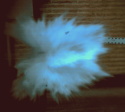
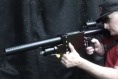
Two more things to consider concerning possible chrony errors caused by the muzzle blast.
1. Vibration through the Chrony itself. The SOS in a metal is much faster than it is through air. The SOS in most metal ranges from about 1300m/s to 5000m/s, roughly 4 to 15 times faster than in air. If there is enough energy in the muzzle blast wave the Chrony will vibrate and may give the second signal from the internal vibration instead of from the projectile crossing the second gate. Any loose connections, less than perfect battery contacts, cold solder joints etc. will make it much more likely that you get a false signal. With a commercial Chrony you don't get to see the waveform so you can't judge if there are two or three (or more) peaks.
Many types of capacitors, particularly ceramic disks, will give an electrical signal when they are vibrated since they are basically piezo transducers. A loud enough muzzle blast may be enough for the cap(s) to act as voltage sources and trigger the Chrony's second gate circuitry.
2. The affect of condensation (as others have mentioned) and pressure gradients in the air can also confuse optical detectors. Pressure gradients give a
Schelerien affect (just like in the high speed photo's of projectiles striking things).
I would think there are ways to minimize the condensation and Schlieren affects. The closer the detector is to the projectile's flight path then the larger the percentage of the detectors "view of the sky" is blocked by the projectile. That will give a much larger swing in the detector output and, I would think, reduce the detectors sensitivity to the muzzle blast. In a perfect setup 100% of the detectors "view of the sky" would be blocked by the projectile. Commercial Chronys typically have a fairly small percentage of the sky blocked by the projectile (perhaps 10%?), that makes it much easier to get the projectile to actually pass through the detection region. But it also means the detector sees the very large blast cloud. The blast cloud is much less dense and blocks less light than the projectile but is also much (maybe much much much) bigger than the projectile.
With a commercial Chrony I don't think there is much you can do to get the projectile's path closer to the detectors, it's just to risky to the detector. You would only have to miss once to destroy the Chrony.
With a homemade chrony it is pretty easy to get the detector very close to the projectile path and easy to limit the field of view of the detector. That makes it easy to get the projectile's shadow to be much bigger than the detectors view of the sky. In my (and others designs) the detector is within ~3/16" of an inch (basically the thickness of the barrel wall) of the projectiles flight path and the detectors field of view at that distance is much less than 1/2" across. That setup gives a very robust change in the light detectors signal and I would think it would be pretty insensitive to the muzzle blast. The peak shape may get distorted a bit but the peak maximum (or center of the peak plateau for a long projectile) should still represent the center of the projectile.
Tech's inductive coils would also be expected to be pretty insensitive to the muzzle blast. To get a true muzzle velocity you would need to move the coils off the barrel.