

I googled, yahooed, and searched to no avail...
Does anyone know the Cd and weight for an off the shelf blowgun dart???
I have no scales sensitive enough to weigh even 10 together so that I can divide... I'm trying to plug some #'s into ggdt and these figures would help greatly if anyone knows them...
TIA
Here's http://www.blowgunshop.com/proddetail.php?prod=SP-100 a link to them specifically...
Cd and weight question...


do you have a harbor freight near your? they sell a scale for ~$15, and a scale is a wonderful investment.
anyway, things like where you purchased the darts, and at least a description would be necessary. a picture would give us a good idea as to the Cd
anyway, things like where you purchased the darts, and at least a description would be necessary. a picture would give us a good idea as to the Cd
POLAND_SPUD wrote:even if there was no link I'd know it's a bot because of female name
click the link in the first postramses wrote:do you have a harbor freight near your? they sell a scale for ~$15, and a scale is a wonderful investment.
anyway, things like where you purchased the darts, and at least a description would be necessary. a picture would give us a good idea as to the Cd



Check with the local post office for an envelope scale. Some convenient stores sell them also, which would be found next to the little baggies and rolling papers 
As far as the drag coefficient, I have no idea.
As far as the drag coefficient, I have no idea.


The weight of a 4" long .40 blowgun dart will be pretty close to 1 gram, give or take about 10%.
The CD is going to be largely defined by the cone shaped tail. An estimation of the Cd of a simple cone shape with it's point into the flow is:
Cd = 0.0056*Angle of point in degrees + 0.162
That cone has an angle of around 25 degrees, so that would give it a Cd of approximately 0.30 (to 2 significant figures)
Hope that helps.
The CD is going to be largely defined by the cone shaped tail. An estimation of the Cd of a simple cone shape with it's point into the flow is:
Cd = 0.0056*Angle of point in degrees + 0.162
That cone has an angle of around 25 degrees, so that would give it a Cd of approximately 0.30 (to 2 significant figures)
Hope that helps.
Does that thing kinda look like a big cat to you?
Thanks Rag for the first straight answer...Ragnarok wrote:The weight of a 4" long .40 blowgun dart will be pretty close to 1 gram, give or take about 10%.
The CD is going to be largely defined by the cone shaped tail. An estimation of the Cd of a simple cone shape with it's point into the flow is:
Cd = 0.0056*Angle of point in degrees + 0.162
That cone has an angle of around 25 degrees, so that would give it a Cd of approximately 0.30 (to 2 significant figures)
Hope that helps.
edit: I think the Cd may be a little lower, ggdt is saying max range of598ft, and I'm sticking these things 2" into plywood at 150yds with very little angle on the barrel(relativly speaking, aiming about 2ft higher than I would at 50-100ft)...or could it be that the point is disturbing the laminar flow enough so that the tail cone is traveling through "dirty" air creating less drag, or is sears-haack coming into play since ggdt does put me in the lower end of transonic(900+fps)???
Now, on a similar but differant note, has anybody on here built a vertical "wind tunnel" to measure terminal velocities, because IIRC, you can calculate Cd from weight and terminal velocity figures, can't you....
I'm guessing a small vert tunnel wouldn't be too hard to construct, a clear 4" tube, a strong fan, and an airspeed indicator...
prolly easier than a fluid tube, since you could reduce the math involved calculating reynolds numbers...
-
jimmy101

- Sergeant Major 2


- Posts: 3210
- Joined: Wed Mar 28, 2007 9:48 am
- Location: Greenwood, Indiana
- Has thanked: 6 times
- Been thanked: 18 times
- Contact:
Yes, you can calculate the Cd from the terminal velocity. You can also calculate Cd from reasonably accurate trajectory data (e.g., range for a given elevation and muzzle velocity), or speed at 1" from muzzle versus speed at a several feet from the muzzle, or hang time + muzzle velocity. The velocity based approaches are probably the simplest.
The challenge with using any kind of wind tunnel is getting the velocity fast enough and getting laminar (smooth) flow through the tube. You are kind of limited in air velocity through say a 4" diameter tube. It doesn't take much air velocity to get turbulent flow through a small diameter tube. IIRC, for say a 4" diameter tube the flow is limited to a few tens of feet per second for laminar flow.
The challenge with using any kind of wind tunnel is getting the velocity fast enough and getting laminar (smooth) flow through the tube. You are kind of limited in air velocity through say a 4" diameter tube. It doesn't take much air velocity to get turbulent flow through a small diameter tube. IIRC, for say a 4" diameter tube the flow is limited to a few tens of feet per second for laminar flow.

I thought that might play into it, but I wasn't sure since I work on motorcycles,not airplanes...jimmy101 wrote:Yes, you can calculate the Cd from the terminal velocity. You can also calculate Cd from reasonably accurate trajectory data (e.g., range for a given elevation and muzzle velocity), or speed at 1" from muzzle versus speed at a several feet from the muzzle, or hang time + muzzle velocity. The velocity based approaches are probably the simplest.
The challenge with using any kind of wind tunnel is getting the velocity fast enough and getting laminar (smooth) flow through the tube. You are kind of limited in air velocity through say a 4" diameter tube. It doesn't take much air velocity to get turbulent flow through a small diameter tube. IIRC, for say a 4" diameter tube the flow is limited to a few tens of feet per second for laminar flow.
And I'm worried that a fluid tube wouldn't accout for transonic phenomena...or would, can a rocket scientist please reply...
unless you are using helium or hydrogen in a pneumatic launcher, or a hybrid launcher, transonic woes won't bother you. as far as Cd determination goes, dropping it from a known height would work too.
and my last post was made before he posted the link
I think air flow would be turbulent at several hundred fps, at least with a blunt tail like that has.
and my last post was made before he posted the link
I think air flow would be turbulent at several hundred fps, at least with a blunt tail like that has.
POLAND_SPUD wrote:even if there was no link I'd know it's a bot because of female name
here a BAD drawing of what I was suggesting about "dirty" air...
the red lines represent, albeit badly, the subsonic pressure wave buildup that is "clearing a path" for reduced drag on the tail cone, and yes I realise my elipsoidal lines look more like supersonic shockwaves, but If I've researched correctly, above 800 fps the pressure buildup starts forming and the sears-haack shape plays into drag...
the red lines represent, albeit badly, the subsonic pressure wave buildup that is "clearing a path" for reduced drag on the tail cone, and yes I realise my elipsoidal lines look more like supersonic shockwaves, but If I've researched correctly, above 800 fps the pressure buildup starts forming and the sears-haack shape plays into drag...
- Attachments
-
- dartflow.jpg (6.89 KiB) Viewed 2553 times
Don't count on it happening every time. :tongue3:jeepkahn wrote:Thanks Rag for the first straight answer.
The speed at which transonic effects start occurring very much depends on the shape.but If I've researched correctly, above 800 fps the pressure buildup starts forming and the sears-haack shape plays into drag...
In this case, because the dart is many dozens of times longer than the tip diameter, any pockets of "clean air" created by the tip will close up significantly before the tail unless the velocity is exceptionally high.
Indeed, such a thing could actually be detrimental - these darts are specifically designed to have the drag forces exerted at the tail, not the nose. I've heard no reports from other people of blowgun darts becoming unstable at higher velocities, so I have to suppose there is no significant difference between the drag characteristics of this and a conventional cone shape.
~~~~~
Now, of course, a cone will in it's own right exhibit variation of Cd with Mach number, as will any other projectile, all dependent on it's own shape.
The subject has been covered at great length by the firearms community, but regrettably, they don't have much desire to fire cones or blowgun darts.
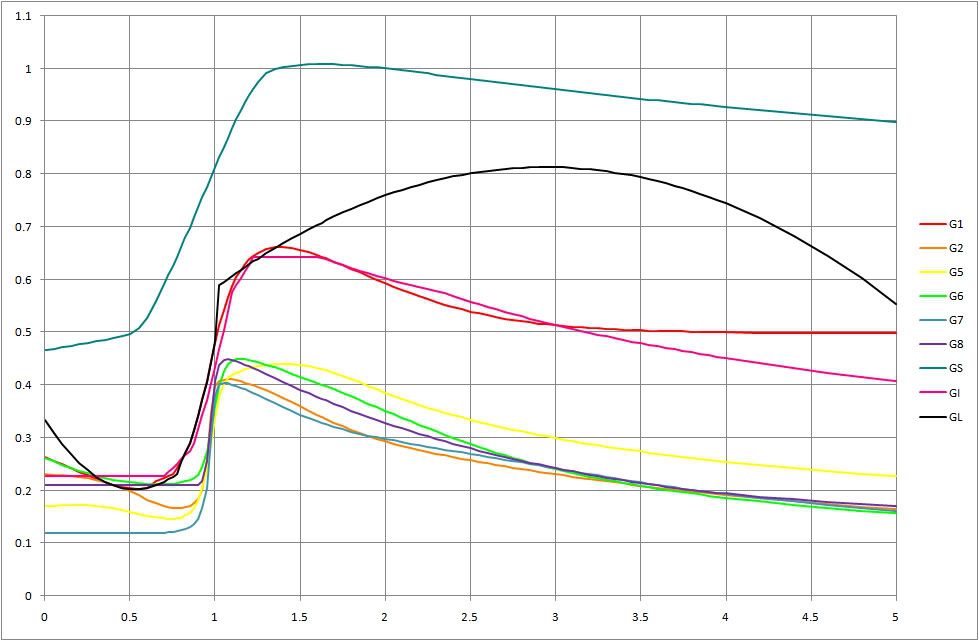
However, they have fired these shapes, and mapped their Cd versus the Mach number.
I managed, with quite significant rooting around, to come across the Cd/Mach # curves, which I've plotted below. Sorry, the GC model isn't shown here.
And a version that's zoomed in on the bit most people are interested in:
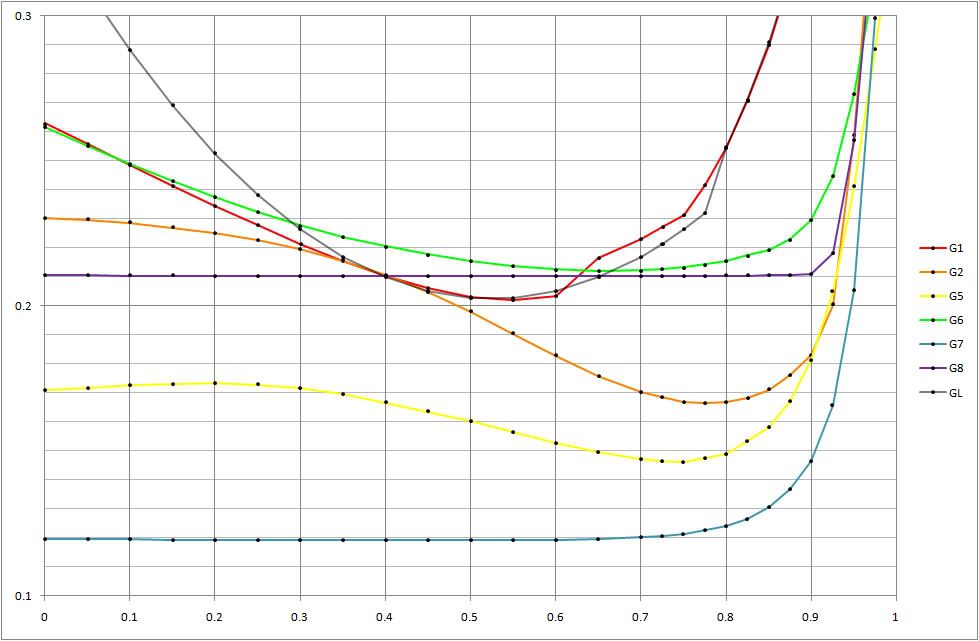
It's interesting to see how much drag varies with Mach number.
~~~~~
Moving onto the notes of determining a valid Cd...
You certainly can use a vertical wind tunnel, however, you would need some fairly high air speeds. Your dart for example would call for air speeds of around 70 miles an hour.
I would also add to what Jimmy has said that you can also calculate it from muzzle velocity and time to a target of known distance (which could be achieved with sound recordings)
One issue that may crop up is that with almost all the methods mentioned is that it becomes increasingly hard to determine the Cd when it's either very low or the sectional density is very high.
This isn't likely to crop up with your blowgun darts, but I do have this problem with one of my own projectile designs.
Does that thing kinda look like a big cat to you?
thanks rag, after looking at those and calculating mv with ggdt, I plugged in Cd of .17(which was g2, because of the similar dimensions, at mach .7)
and the ballistics calculator is now showing trajectories that coincide with real world firing... I know that as it decelerates the(edit for brainfart) Cd # will rise slightly, but knowing the Cd on muzzle exit will prolly be as accurate as using the static Cd...
and the ballistics calculator is now showing trajectories that coincide with real world firing... I know that as it decelerates the(edit for brainfart) Cd # will rise slightly, but knowing the Cd on muzzle exit will prolly be as accurate as using the static Cd...
Last edited by jeepkahn on Fri Mar 27, 2009 9:37 am, edited 1 time in total.
-
POLAND_SPUD

- Captain

- Posts: 5402
- Joined: Sat Oct 13, 2007 4:43 pm
- Been thanked: 1 time
@jeepkahn
so in most cases if you put the cd of the projectile while it's leaving the barrel you won't get accurate results (ggdt will show that the max range is lower than it really is)
instead of asking how good would a given projectile perform you can test it... I am sure it will give you more accurate results
AFAIK mach number is speed... so when it decelerates the mach number fallsknow that as it decelerates the mach # will rise slightly
Again AFAIK it's not that easy... Cd for projectiles moving at the SOS (or close to the SOS) is high... but becasue it's high the projectile decelerates fast... as it's speed is being reduced it's cd is being reduced too...but knowing the Cd on muzzle exit will prolly be as accurate as using the static Cd...
so in most cases if you put the cd of the projectile while it's leaving the barrel you won't get accurate results (ggdt will show that the max range is lower than it really is)
instead of asking how good would a given projectile perform you can test it... I am sure it will give you more accurate results
Children are the future
unless we stop them now
unless we stop them now
Actually, the graphs that rag posted shows that for certain shapes, the Cd decreases when speeds exceed .6 mach, so the drag is reduced the faster it goes until it reaches critical mach and creates a shockwave that then increase drag...POLAND_SPUD wrote:Again AFAIK it's not that easy... Cd for projectiles moving at the SOS (or close to the SOS) is high... but becasue it's high the projectile decelerates fast... as it's speed is being reduced it's cd is being reduced too...
I also edited my last post, because I meant to say Cd# not Mach #...