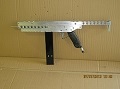
I have built a pneumatic potato/tennis ball lancher (with compressed air). I need to develop theory (i.e. equations and formula) to determine the velocity as the ball leaves the barrel. I have the projectile motion after the ball leaves the barrel down pretty well. I'm having issues accounting for pressure drop among other things.
As seen in the attached picture, there is a PVC resevoir with has compressed air. The valve opens by a current from the battery and the air shoots the ball out. Note I need physics forumlas and not a link to a projectile motion calculator site.
Thank you.
Pneumatic Cannon Theory Help (Internal Ballistics)
-
wannabe_genius
- Recruit

- Posts: 1
- Joined: Sun Oct 14, 2007 10:02 pm
- Attachments
-
- Air Cannon Pic2.jpg (38.31 KiB) Viewed 6915 times


i know that this post isnt of much help, but i think that most people here (such as myself) just build and shoot cannons for the fun of it. some people do take it into a science and deturmine ratios and formulas and things like that, but for the most part people just do it for fun.
im not trying to put you down or make you feel like an idiot, but basicly the more pressure you put in it, the farther the tennis ball goes.
also, whats the upside down protractor for? you would need a board or something to put it against for it to do anything at all.
im not trying to put you down or make you feel like an idiot, but basicly the more pressure you put in it, the farther the tennis ball goes.
also, whats the upside down protractor for? you would need a board or something to put it against for it to do anything at all.
"physics, gravity, and law enforcement are the only things that prevent me from operating at my full potential" - not sure, but i like the quote
you know you are not an engineer if you have to remind yourself "left loosy righty tighty"
you know you are not an engineer if you have to remind yourself "left loosy righty tighty"
-
silverdooty
- Specialist

- Posts: 102
- Joined: Mon Aug 06, 2007 8:52 pm
- Location: old folks home
just add a weighted string and you have an el cheapo elevation gauge.also, whats the upside down protractor for? you would need a board or something to put it against for it to do anything at all.
anyway wannabe, check out the CALM site for some info.
http://www.qsl.net/wb6zqz/calm.html
then download calm.py open it up in wordpad and you can see the actually formulas they use.
Last edited by silverdooty on Sun Oct 14, 2007 11:00 pm, edited 2 times in total.
-
SpudBlaster15
- First Sergeant 3


- Posts: 2400
- Joined: Wed Oct 18, 2006 11:12 pm
- Has thanked: 2 times
- Been thanked: 10 times
Lorem ipsum dolor sit amet, consectetur adipiscing elit. Cras nec placerat erat. Vivamus dapibus egestas nunc, at eleifend neque. Suspendisse potenti. Sed dictum lacus eu nisl pretium vehicula. Ut faucibus hendrerit nisi. Integer ultricies orci eu ultrices malesuada. Fusce id mauris risus. Suspendisse finibus ligula et nisl rutrum efficitur. Vestibulum posuere erat pellentesque ornare venenatis. Integer commodo fermentum tortor in pharetra. Proin scelerisque consectetur posuere. Vestibulum molestie augue ac nibh feugiat scelerisque. Sed aliquet a nunc in mattis.
Last edited by SpudBlaster15 on Wed Jul 14, 2021 5:53 pm, edited 4 times in total.
-
homedepotpro
- Specialist 4

- Posts: 443
- Joined: Sun Nov 26, 2006 1:00 am
im just putting this out there; you could build a simple chrono.
edit:is this for a school project?
edit:is this for a school project?
Last edited by homedepotpro on Sun Oct 14, 2007 10:58 pm, edited 1 time in total.

-
jackssmirkingrevenge

- Five Star General

- Posts: 26219
- Joined: Thu Mar 15, 2007 11:28 pm
- Has thanked: 582 times
- Been thanked: 348 times
As far as the equations go, I suggest you contact the man behind this site. As to determining the actual velocity of your projectile, it's relatively cheap to invest in a shooting chrony.
hectmarr wrote:You have to make many weapons, because this field is long and short life
-
jimmy101

- Sergeant Major 2


- Posts: 3210
- Joined: Wed Mar 28, 2007 9:48 am
- Location: Greenwood, Indiana
- Has thanked: 7 times
- Been thanked: 18 times
- Contact:
Modelling the internal ballistics of a gun, particularly a compressed air gun is non-trivial. GGDT contains some pretty heavy duty mathematics and physics.
I think your best bet is to make a number of assumptions so things are more tractable.
Ignore the pressure drop across the valve and through the plumbing. Assume the valve opens instantenously. Ignore the static friction between the ammo and barrel and assume there is zero dead volume between the valve and projectile.
Set the calculation up as small times steps, say 1 millisecond (or less).
The pressure at time zero is simply the resevoir pressure. The force on the projectile is the pressure*area. The acceleration is a=F/m. The velocity at the end of the time step is the velocity at the previous step plus (time step size)(acceleration). The position at the end of the time step is the previous position plus the (time step size)(velocity)
Since the projectile has moved the chamber volume has expanded. So, volume at time i is the volume at time zero + (distance projectile moved) X (area of barrel). If you ignore temperature affects then the pressure in the system just drops by the ratio of the initial and the current volumes. (I believe GGDT treats the affects of the drop in temperature.) You can take into account the temperature affects, post back if you get to that point.
The calculation just repeats until the projectile has moved the length of the barrel.
As a refinement, you can include the affect of friction between the projectile and the barrel. The force equation just changes from F=ma to F=ma+(frictional force), rearranging gives the acceleration; a=(F-frictional force)/m.
I think your best bet is to make a number of assumptions so things are more tractable.
Ignore the pressure drop across the valve and through the plumbing. Assume the valve opens instantenously. Ignore the static friction between the ammo and barrel and assume there is zero dead volume between the valve and projectile.
Set the calculation up as small times steps, say 1 millisecond (or less).
The pressure at time zero is simply the resevoir pressure. The force on the projectile is the pressure*area. The acceleration is a=F/m. The velocity at the end of the time step is the velocity at the previous step plus (time step size)(acceleration). The position at the end of the time step is the previous position plus the (time step size)(velocity)
Since the projectile has moved the chamber volume has expanded. So, volume at time i is the volume at time zero + (distance projectile moved) X (area of barrel). If you ignore temperature affects then the pressure in the system just drops by the ratio of the initial and the current volumes. (I believe GGDT treats the affects of the drop in temperature.) You can take into account the temperature affects, post back if you get to that point.
The calculation just repeats until the projectile has moved the length of the barrel.
As a refinement, you can include the affect of friction between the projectile and the barrel. The force equation just changes from F=ma to F=ma+(frictional force), rearranging gives the acceleration; a=(F-frictional force)/m.

Create an account or sign in to join the discussion
You need to be a member in order to post a reply
Create an account
Not a member? register to join our community
Members can start their own topics & subscribe to topics
It’s free and only takes a minute
Sign in
-
- Similar Topics
- Replies
- Views
- Last post