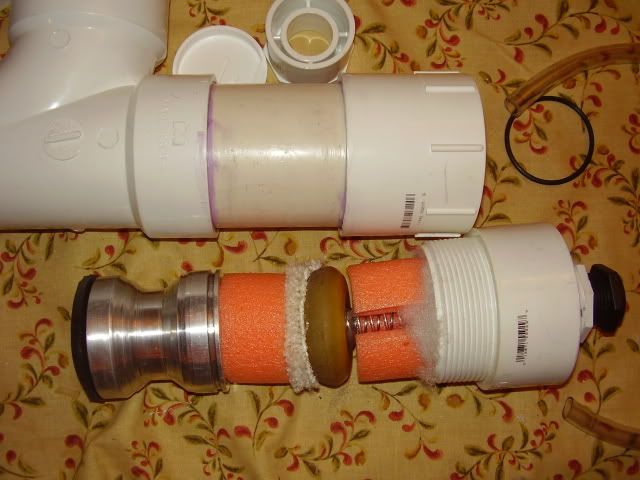
jmccalip wrote:I am making a 3" barrel sealing piston valve with 2" porting. My piston weighs 15oz(aluminum).
I have expensive PVC parts, and I don't want to mess this up. I want to make sure I have enough room to house a large bumper, but is this too big? I plan to vent the pilot with a 1" sprinkler valve.
Here is the size I am considering:
ALL PIECES ARE NOW SCD 40/80.
Couldn't I always fill it with dead space to take away from the volume?[/b]
Not breaking things is a good idea. There are several things to take into consideration. How much energy will the piston have to hammer away at the parts? How much slow down cushion does it have to reduce the peak forces? How does pilot volume affect this?
The further a piston moves pushed by air the more kinetic energy it can pick up. By limiting the area it is free to accelerate limits this energy.
Having a fairly long deceleration zone reduces impact forces. A long bumper is good, but may increase the space for acceleration.
The ratio of of the valve seat diameter to the piston diameter sets the pressure in the pilot area where the valve opens. If this is low due to a low diameter ratio, the compressing air provides little piston braking. If the ratio is high, the valve is slower to open (lower force) and the higher pressure being squeezed in the pilot area aids in slowing the piston. Slower pistons are safer for PVC.
I try to limit my piston travel to about 1/2 the valve seat diameter. The last 1/3rd of travel is in the bumper slowing it down. You may want more bumper for safety.
I used to crack PVC valves in more aggressive piston ratio valves on a regular basis.