question about size of sealing face
-
cfb_rolley

- Specialist


- Posts: 168
- Joined: Tue Mar 24, 2009 11:11 pm
This is just a quick one, if the sealing face of my piston is the same diameter or smaller than what it seals against, will the valve still work, and if so how would it affect performance? Because my train of though is if the entire front face of the piston is sealed against the seat, then no force from the chamber pressure can act upon that face, meaning it would either not work, or not open until the pilot chamber is at a very low pressure?
-
Technician1002

- Captain

- Posts: 5189
- Joined: Sat Apr 04, 2009 11:10 am
Due to the width of the seal, most often the outside diameter is not a tight seal and the actual gas seal is more toward the barrel opening so as the pilot pressure approaches zero, the force on the seal becomes less increasing edge leakage between the piston and seat. This will open the valve just fine as long as the OD of the piston is bigger than the seat diameter. It is very difficult to get a 100% seal right at the very outside edge of the piston face without an o ring.
What is required is the seal is smaller than the OD of the piston to work.
If you are concerned about it, you could very slightly bevel the outside edge of the valve seat so as the pilot pressure drops, the piston will unseat the outer diameter of the seat so the effective seal is close to the diameter of the ID of the barrel.
The piston remaining closed until the pilot is at low pressure is a good thing. When it does pop open, the pilot has little pressure behind the piston to slam it back closed while the chamber pressure is still dropping. The Wiki has some more info on this subject under piston valves.
http://www.spudfiles.com/spud_wiki/inde ... ston_valve
The disadvantage with close ratio piston valves is they tend to missfire if the piston leaks too much into the pilot preventing the required pressure drop. An o ring on the piston is often needed to make this type of valve function properly.
You can hear the function of a close ratio piston here. There is a hiss as the pilot is vented followed by the main valve popping open. A large high flow pilot valve is not required to have a fast main piston.
http://www.spudfiles.com/forums/download,id,14935.html
What is required is the seal is smaller than the OD of the piston to work.
If you are concerned about it, you could very slightly bevel the outside edge of the valve seat so as the pilot pressure drops, the piston will unseat the outer diameter of the seat so the effective seal is close to the diameter of the ID of the barrel.
The piston remaining closed until the pilot is at low pressure is a good thing.
When it does pop open, the pilot has little pressure behind the piston to slam it back closed while the chamber pressure is still dropping. The Wiki has some more info on this subject under piston valves.http://www.spudfiles.com/spud_wiki/inde ... ston_valve
The disadvantage with close ratio piston valves is they tend to missfire if the piston leaks too much into the pilot preventing the required pressure drop. An o ring on the piston is often needed to make this type of valve function properly.
You can hear the function of a close ratio piston here. There is a hiss as the pilot is vented followed by the main valve popping open. A large high flow pilot valve is not required to have a fast main piston.
http://www.spudfiles.com/forums/download,id,14935.html
-
cfb_rolley
- Specialist
- Posts: 168
- Joined: Tue Mar 24, 2009 11:11 pm
ahh i thought so. what i was going to do was use a pvc15 pressure rated joiner as the body of my piston, but the barrel is also pvc15 pressure rated, and the end of the pipe is not a massive area to be sealing against so i was going to use a pvc15 joiner on the end and sand it flush to give more seat area. or would that not be necessary?
-
jackssmirkingrevenge

- Five Star General

- Posts: 26219
- Joined: Thu Mar 15, 2007 11:28 pm
- Has thanked: 582 times
- Been thanked: 348 times
Another disadvantage especially in the case of high pressure launchers is that the force keeping the piston shut is spread on a very small area, putting a lot of stress on the seal material.Technician1002 wrote:The disadvantage with close ratio piston valves is they tend to missfire if the piston leaks too much into the pilot preventing the required pressure drop.
hectmarr wrote:You have to make many weapons, because this field is long and short life
-
cfb_rolley
- Specialist
- Posts: 168
- Joined: Tue Mar 24, 2009 11:11 pm
what sort of high pressures are we talking? The pipe i'll be using is rated to 145 psi, but i doubt i'd ever go over 90psi due to my compressor.
-
Technician1002
- Captain
- Posts: 5189
- Joined: Sat Apr 04, 2009 11:10 am
If the valve seat is a narrow edge of a pipe, and the piston is larger, the force can be high enough to damage the rubber seal at well under 100 PSI. A 4 inch piston with a 2 inch barrel at 100 PSI has over 300 LBS on the seat. This can cut it in larger piston sizes. The fix is a wider valve seat.
In some of my valves, I put a coupler on the pipe to give the piston more area to rest on. In this example below, the gasket was put in the valve seat instead of on the piston. For area for the piston to rest on without damaging the seal, the piston can rest on the barrel inside and on the coupler added to the barrel on the outside. This limits how much pressure can be applied to distorting the rubber.
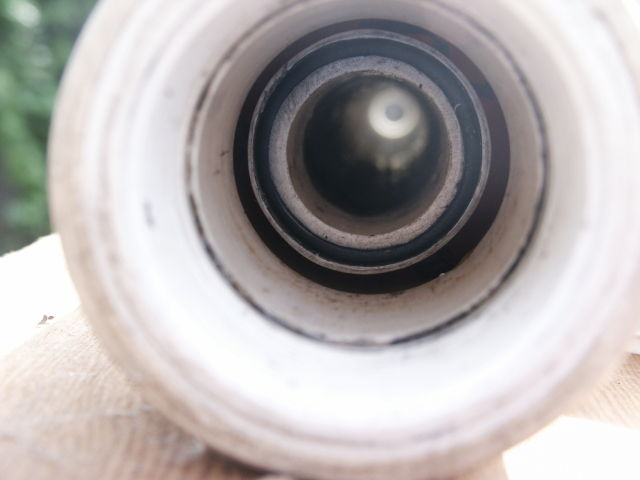
Photo Mouse Musket valve seat. Barrel 1 inch. Valve seat diameter 1.25 inch. Piston OD 1.5 inch. This is the cannon in the sound file in my prior post.
You can calculate the force the piston has on the face. Find the area sealed by the piston. In the example above, the seal diameter is 1.25 inches. Calculate area inside the circle and multiply by the air pressure.
Area of the circle is Pi X Radius squared.
1.25 = radius of 0.625.
625 squared is 0.390625
Pi times 0.390625 is about 1.25 square inches. At 100 PSI that little gasket could have over 120 lbs of force squishing it.
Calculate the pressure on your design and make the support proper to hold it.
In some of my valves, I put a coupler on the pipe to give the piston more area to rest on. In this example below, the gasket was put in the valve seat instead of on the piston. For area for the piston to rest on without damaging the seal, the piston can rest on the barrel inside and on the coupler added to the barrel on the outside. This limits how much pressure can be applied to distorting the rubber.
Photo Mouse Musket valve seat. Barrel 1 inch. Valve seat diameter 1.25 inch. Piston OD 1.5 inch. This is the cannon in the sound file in my prior post.
You can calculate the force the piston has on the face. Find the area sealed by the piston. In the example above, the seal diameter is 1.25 inches. Calculate area inside the circle and multiply by the air pressure.
Area of the circle is Pi X Radius squared.
1.25 = radius of 0.625.
625 squared is 0.390625
Pi times 0.390625 is about 1.25 square inches. At 100 PSI that little gasket could have over 120 lbs of force squishing it.
Calculate the pressure on your design and make the support proper to hold it.
-
cfb_rolley
- Specialist
- Posts: 168
- Joined: Tue Mar 24, 2009 11:11 pm
i think i'll go ahead with the coupler idea, just to be safe. i'd much rather make a close ratio piston work than build a cannon that destroys piston faces. But i will definitely use o-rings. In that case, i couldn't use a equalization Hole, i'd have to work out a check valve wouldn't I?
-
Technician1002
- Captain
- Posts: 5189
- Joined: Sat Apr 04, 2009 11:10 am
EQ hole works fine. Just make it tiny. The EQ orifice must be considerably smaller than the pilot valve orifice.

EQ hole in the original piston that broke.

EQ hole in the original piston that broke.
-
cfb_rolley
- Specialist
- Posts: 168
- Joined: Tue Mar 24, 2009 11:11 pm
one last question, if i used o-rings, could i use a peice of compressor hose leading from the pilot to the chamber with a ball valve at the pilot end as my check valve instead of a eq hole? Basically, out of curiousity, and because i have those parts laying around at home anyway.


If the compressor hose goes through the piston, and if the inner diameter of the compressor hose is very small, yes.
-
cfb_rolley
- Specialist
- Posts: 168
- Joined: Tue Mar 24, 2009 11:11 pm
that's a pretty good idea too, but i'm talking external. So it's a simple piston design, but instead of using a ball valve as an inlet valve i use a T fitting threaded into the pilot with a ball valve on each side, one for inlet and one that has a hose that leads to a fitting threaded into the chamber, that way i can shut off that ball valve meaning no air can leak back into the pilot, theoretically making it totally reliable and not making a weak point in the piston.
Yes, that will work quite well. It's a system JSR is rather fond of.
-
cfb_rolley
- Specialist
- Posts: 168
- Joined: Tue Mar 24, 2009 11:11 pm
oh awesome, well i guess i'll try that out then. Thanks for the help!
-
jackssmirkingrevenge
- Five Star General
- Posts: 26219
- Joined: Thu Mar 15, 2007 11:28 pm
- Has thanked: 582 times
- Been thanked: 348 times
Is it? Doesn't strike me as familiar.saefroch wrote:It's a system JSR is rather fond of.
hectmarr wrote:You have to make many weapons, because this field is long and short life
Create an account or sign in to join the discussion
You need to be a member in order to post a reply
Create an account
Not a member? register to join our community
Members can start their own topics & subscribe to topics
It’s free and only takes a minute
Sign in
-
- Similar Topics
- Replies
- Views
- Last post
-
- 3 Replies
- 1944 Views
-
Last post by c19o
-
- 11 Replies
- 4423 Views
-
Last post by qwerty
-
- 6 Replies
- 2111 Views
-
Last post by spudgunnerwryyyyy
-
- 3 Replies
- 4044 Views
-
Last post by Fnord
-
- 3 Replies
- 1803 Views
-
Last post by deusXmachina